TENTSMUIR 3
 |  |  |
|---|---|---|
 |  |  |
 |
Statement
The idea of working outside seemed daunting and impractical to me before I began this project. I was concerned about factors such as the wind and rain which were beyond my control. However, after listening to a talk by Alison Philp about her outdoor working practice, I felt it was something I needed to try. Philp’s talked about the ability to relinquish control when working outside, and even stated that some of her drawings blow away when they are finished. I felt this process of working sounded exciting and full of fortuitous outcomes. My approach to drawing changed instantly when outside, I stopped trying to plan and control the marks I was making and instead let the environment dictate the outcome.
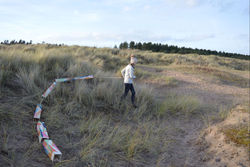
I visited Tentsmuir forest where I set up a board amongst the dunes. As time progressed I realised that I wasn’t viewing the work as a painting, it had become an installation in the landscape. When the painting was finished and transported back to the studio it served as nothing more than a piece of documentation. The site specific land art had been destroyed by the removal from the environment where it was created.
When I painted three more canvases in the dunes, I documented the installation as I knew it was something which couldn’t be reproduced. The place I visited would cease to exist, the atmosphere of the landscape constantly changes and evolves. Because of this process of creating and destroying, the making of the installations became a performance. I struggled with effectively photographing the final outcome. The way the landscape was viewed in the images was completely different to real life. The sound, smell and atmosphere was lost in the pictures and replaced by far too much visual information, far more than would be noticed if the installation was viewed in real life.
My final piece was made from five pillars, the square canvases had been too abrupt in the landscape. The birch trunks were more fitting with the scenery, particularly as I left the grain of the wood visible after they are painted. The branches could be viewed from all angles; the varied heights helped them to blend in with the undulating dunes. I approached the documentation of this piece a lot more like a performance. I filmed the posts being dragged to and from the site and around the sandbanks, which created an array of sounds and allowed the dust and dirt from the landscape to become part of the logs. The combination of the documentation style and Tentsmuir’s physical presence on the artwork made a more accurate portrayal of my connection with the environment. Documenting the process of creating the columns was more important than photographing the final outcome.
By the end of my trip to Tentsmuir, I realised I had accomplished what I set out to achieve in this project. Through refining the materials I used, the documentation process and my approach, I created an ephemeral installation which responded to the environment in a particular time and place.